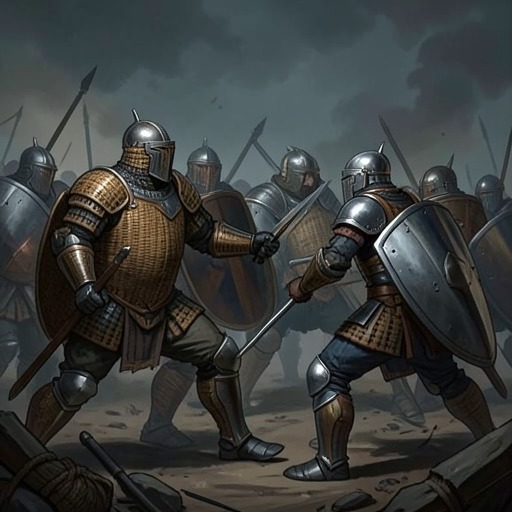
Wugu tribe’s rattan armour
The Romance of the Three KingdomsWugu tribe’s rattan armour is the defining protection of Wutugu’s army: repeatedly oil-soaked until arrows and swords cannot penetrate it, yet buoyant enough to carry its wearers across rivers. It seems to make the Wugu fighters invincible, but its oil-treated surface also turns the armour into fuel. Kong Ming lures the army into a confined valley and sets it ablaze, transforming the tribe’s greatest military advantage into the cause of a catastrophic defeat.
Construction and Military Use
The armour belongs to the Wugu tribe, whose chieftain Wutugu becomes Meng Huo’s last potential ally after Meng Huo has been repeatedly captured and released by Kong Ming. The account emphasizes the material process behind the protection: the rattan is soaked in oil as many as ten times. This treatment makes the armour impervious to arrows and swords, while also allowing it to float, so the soldiers can cross rivers with it. The same object therefore combines battlefield defense with practical mobility.
Wutugu agrees to aid Meng Huo, and some thirty thousand men answer the call. They march against Kong Ming as far as Peach Blossom river. In the ensuing fight, the Shu army can find no way to penetrate the rattan, and its troops retreat. The Wugu fighters do not press their advantage, instead returning to their camp. Even so, the encounter makes the armour’s reputation plain: ordinary weapons cannot stop its wearers, and Kong Ming’s officers advise retreat because the desolate territory seems to offer little reward for further struggle.
The Trap at the Valley
Kong Ming refuses to withdraw. Reconnoitring the ground, he finds a winding valley whose shape suits his plan, then gives Ma Dai the task of preparing the route with ten black carriages and a thousand bamboo poles. The rattan armour’s strength has dictated the next move: rather than try to overcome it with arrows or swords, Kong Ming chooses terrain and fire as the means of defeating it.
As the Wugu army advances through the valley, its soldiers pass wagons that appear abandoned and take them as evidence that the enemy has fled too quickly to carry away its supplies. At the far end, huge tree trunks block the road; rocks crash down from above and close the route behind them. While Wutugu’s men try to clear the obstruction, blazing wagons roll into their path. When they turn back, the wagons they passed earlier are burning too, sealing the entrance. The apparently discarded carts have become barriers in a trap with no safe direction of escape.
Wutugu sees that the hillsides have no brush to catch fire and tries to lead his men up the slopes. But flaming brands are hurled down at selected points, igniting fuses and landmines buried in the ground. The valley erupts. Fire spreads across it, and the armour’s oil-soaked rattan catches alight. What had resisted arrows and blades now binds the soldiers to a burning surface: the protection becomes, in the narration’s stark image, their funeral clothes. The confined terrain, blocked exits, and incendiaries work together to nullify the armour’s defenses.
Destruction and Meaning
The disaster kills Wutugu and all thirty thousand of his men. Their defeat also ends the last military hope offered to Meng Huo’s depleted forces: after the earlier releases, he had been told that the Wugu tribe was his final hope, and Kong Ming’s victory destroys that prospect. The armour is thus not merely a striking piece of equipment. It marks the final escalation of resistance in the southern campaign, and its defeat clears the way for the campaign’s larger purpose of securing submission.
The victory is not presented as costless triumph. From the clifftop, Kong Ming watches the burning and weeps at the terrible sight. He says that, although the attack serves the Han, ordering it will shorten his life. His response places the armour at the center of a grim reversal: Kong Ming’s strategic ingenuity succeeds precisely because it discovers how the tribe’s defense can be turned against it, but the method brings mass death that even the victorious strategist cannot regard without anguish. The armour’s narrative significance lies in that double turn—from invulnerability to fatal vulnerability, and from tactical success to moral burden.